
By the time a proposed location reaches an investment committee, the business should understand its anticipated capital requirement, projected operating performance, material lease obligations and outstanding risks.
The committee's responsibility is to determine whether the proposed investment is an appropriate use of the company's capital and operating resources.
For a growing retail or restaurant brand, establishing this discipline early becomes particularly important as the expansion pipeline grows. Approving several individually attractive locations can create a collective capital commitment or opening schedule that the business is poorly positioned to support.
The committee needs enough information to assess each opportunity within that wider context.
Define the approval being requested
Real estate opportunities progress through different levels of commitment. The information required to authorise preliminary due diligence is considerably different from the information required to approve a ten-year lease and a $750,000 capital investment.
A useful governance process establishes what authority is being granted at each stage.
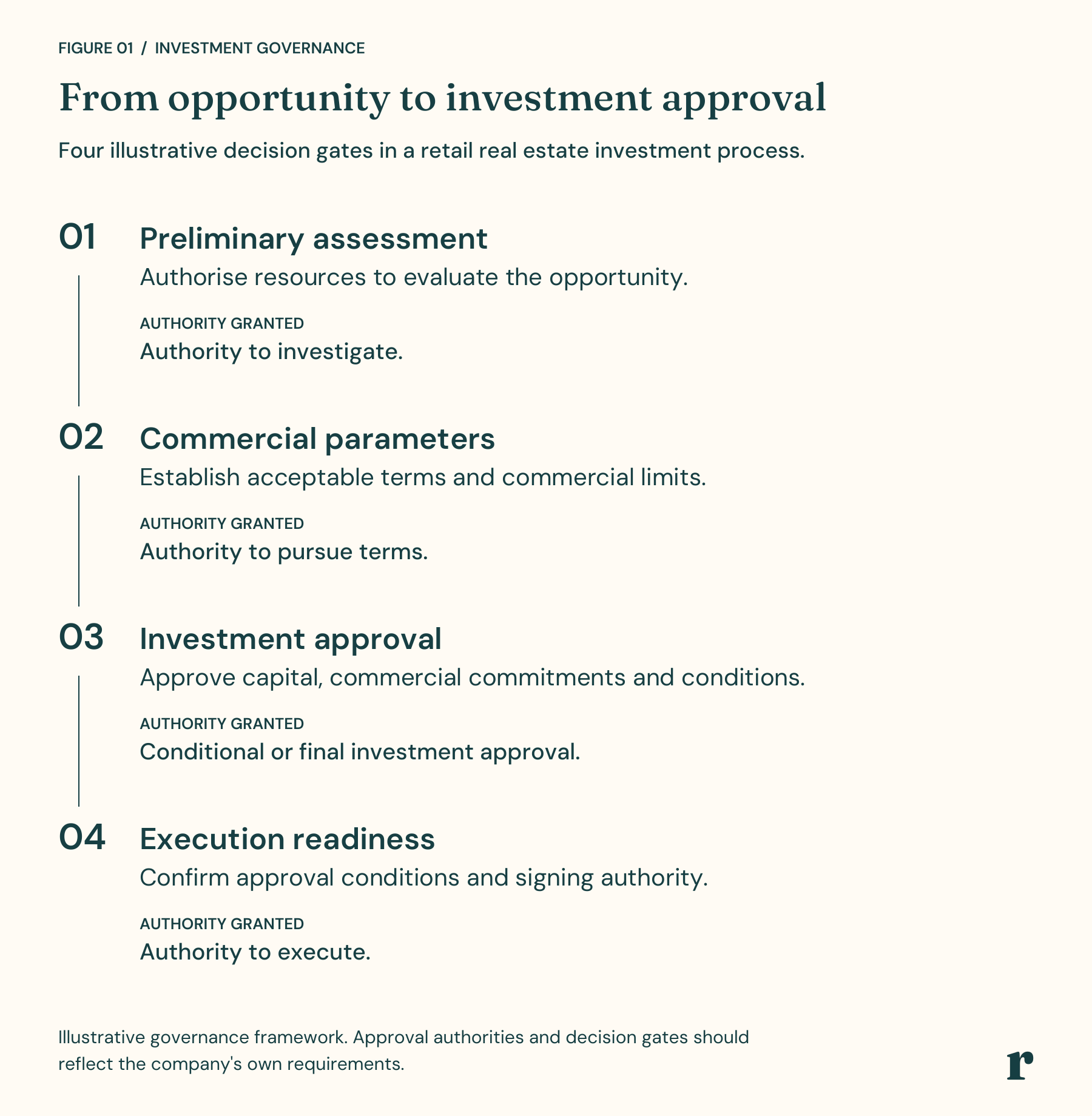
Data and framework for Figure 01
| Decision stage | Approval being requested |
|---|---|
| Preliminary assessment | Allocate resources to evaluate the opportunity |
| Commercial parameters | Authorise appropriately designated parties to pursue terms within agreed parameters |
| Investment approval | Approve the proposed capital allocation and commercial commitment, subject to specified conditions |
| Execution readiness | Confirm that approval conditions have been satisfied and authorised signatories may proceed |
Complete graphic text equivalent
- Preliminary assessment
Authorise resources to evaluate the opportunity.
Authority granted: Authority to investigate.
- Commercial parameters
Establish acceptable terms and commercial limits.
Authority granted: Authority to pursue terms.
- Investment approval
Approve capital, commercial commitments and conditions.
Authority granted: Conditional or final investment approval.
- Execution readiness
Confirm approval conditions and signing authority.
Authority granted: Authority to execute.
Illustrative governance framework. Approval authorities and decision gates should reflect the company's own requirements.
The process should reflect the company's own governance structure, delegated authorities and legal requirements.
For example, a committee may authorise further investigation of a restaurant location before the mechanical capacity and construction scope have been confirmed. That approval should not subsequently be interpreted as authority to execute a lease.
Where the landlord has imposed a deadline, the recommendation should identify what can reasonably be established within that period and what protections would be required if material questions remain outstanding.
Establish the strategic rationale
The market assessment should explain why the proposed location belongs in the company's expansion plan.
For a new store, that includes the addressable customer base, competitive environment, accessibility and the location's relationship to the existing network. A proposed opening in an established market may require a different justification from the first store in a new region.
The first location in a new market may carry additional distribution costs, require greater marketing investment and take longer to establish brand awareness. Those implications belong in the investment assessment.
Within an existing market, the committee should understand whether the proposed store expands customer coverage, relieves capacity constraints or transfers revenue from nearby locations.
The package should also identify competing opportunities for the same capital. A proposed opening may meet the company's investment criteria while ranking below a renewal, relocation or another market already in the development pipeline.
That comparison becomes increasingly important when construction resources, opening teams or available capital are constrained.
Complete the cross-functional review before committee
A real estate recommendation should incorporate the requirements of the teams responsible for delivering and operating the location.
The review needs to establish the commercial consequences of their findings.
| Function | Examples of required input |
|---|---|
| Finance | Sales assumptions, capital availability, EBITDA, investment returns and sensitivity analysis |
| Operations | Staffing model, customer throughput, receiving, storage and service capacity |
| Construction | Building condition, servicing capacity, fit-out scope, capital estimates and delivery schedule |
| Marketing | Customer profile, local brand awareness and opening support requirements |
| Legal | Lease obligations, contractual protections, approval conditions and execution requirements |
For a restaurant, construction may identify that the proposed exhaust route requires landlord consent and substantial structural work. Operations may determine that the available kitchen footprint limits production capacity during peak periods.
Both findings affect the investment case. The construction requirement may increase capital expenditure and delay opening, while the operational constraint may undermine the sales forecast.
These issues should be reflected in the recommendation before the committee convenes, with unresolved items identified alongside their potential financial or operational consequences.
Present the full commercial commitment
The proposed lease terms should be summarised in sufficient detail for the committee to understand the obligations associated with the investment.
The economic assessment should include net rent, additional rent, scheduled escalations, landlord contributions, fixturing periods and rent commencement.
Structural lease provisions deserve attention where they affect the business's ability to operate, protect its investment or manage the location over time.
A demolition provision exercisable during the initial lease term, for example, may expose a retailer to the loss of unrecovered capital. An assignment restriction may limit future portfolio restructuring. A permitted-use provision may constrain the introduction of new product categories or services.
Landlord contributions should also be assessed against their payment conditions. A contribution payable after opening may reduce the net investment while leaving the retailer responsible for funding the entire construction programme in advance.
The committee should understand the material commercial terms supporting the recommendation, with final documentation reviewed by the company's legal counsel and regulated transaction activities handled by appropriately authorised parties.
Compare the available alternatives
Renewal decisions provide a useful example of why investment committees should assess more than new openings.
Consider a hypothetical retailer operating a profitable store approaching the end of its initial lease term. The store requires refurbishment, and the landlord has proposed an increase in rent. An alternative location nearby offers lower occupancy costs and a more efficient layout.
The existing store generates $2.4 million in annual sales, with store-level EBITDA of $288,000 before the proposed rent increase.
The landlord's renewal proposal would increase annual occupancy costs by $30,000. Assuming other operating conditions remain unchanged, annual store-level EBITDA would decline to $258,000.
A relocation could reduce occupancy costs and improve operating efficiency, but would require a substantially larger capital commitment.
| Investment consideration | Renew and refurbish | Relocate |
|---|---|---|
| Annual sales at stabilisation | $2,400,000 | $2,400,000 |
| Annual occupancy cost | $180,000 | $150,000 |
| Occupancy cost as % of sales | 7.50% | 6.25% |
| Net refurbishment or fit-out investment | $150,000 | $450,000 |
| Additional transition costs | $0 | $50,000 |
| Total initial investment | $150,000 | $500,000 |
| Annual store-level EBITDA at stabilisation | $258,000 | $308,000 |
| Store-level EBITDA margin | 10.75% | 12.83% |
The relocation scenario assumes $30,000 in annual occupancy savings and a further $20,000 in annual operating efficiencies relative to the renewal.
Relocation therefore requires an additional $350,000 in initial investment to generate an anticipated $50,000 in additional annual EBITDA at stabilisation.
All financial figures in this article are illustrative and do not represent market benchmarks.
The committee can now evaluate the commercial trade-off. Under simplified assumptions, the additional investment represents seven years of the projected incremental annual EBITDA.
That calculation excludes the time required to achieve stabilised performance, the time value of money, tax, working capital and subsequent capital expenditure. A full investment assessment would need to incorporate those factors.
The recommendation may change if the existing landlord agrees to a refurbishment contribution, if the alternative location supports a credible increase in sales or if the current premises impose operating constraints that are expected to become more significant.
The purpose of the comparison is to establish which assumptions justify the additional commitment and whether those assumptions are sufficiently supported.
Show where the investment case is vulnerable
The base-case forecast should be accompanied by an assessment of the assumptions most likely to affect the recommendation.
For the relocation example, customer retention is particularly important. The proposed location may offer a more efficient layout, but the existing store has an established customer base and trading history.
Assume the relocated store stabilises at annual sales 5% below the base-case forecast. At an assumed incremental contribution margin of 35%, the $120,000 revenue shortfall would reduce projected annual EBITDA by $42,000.
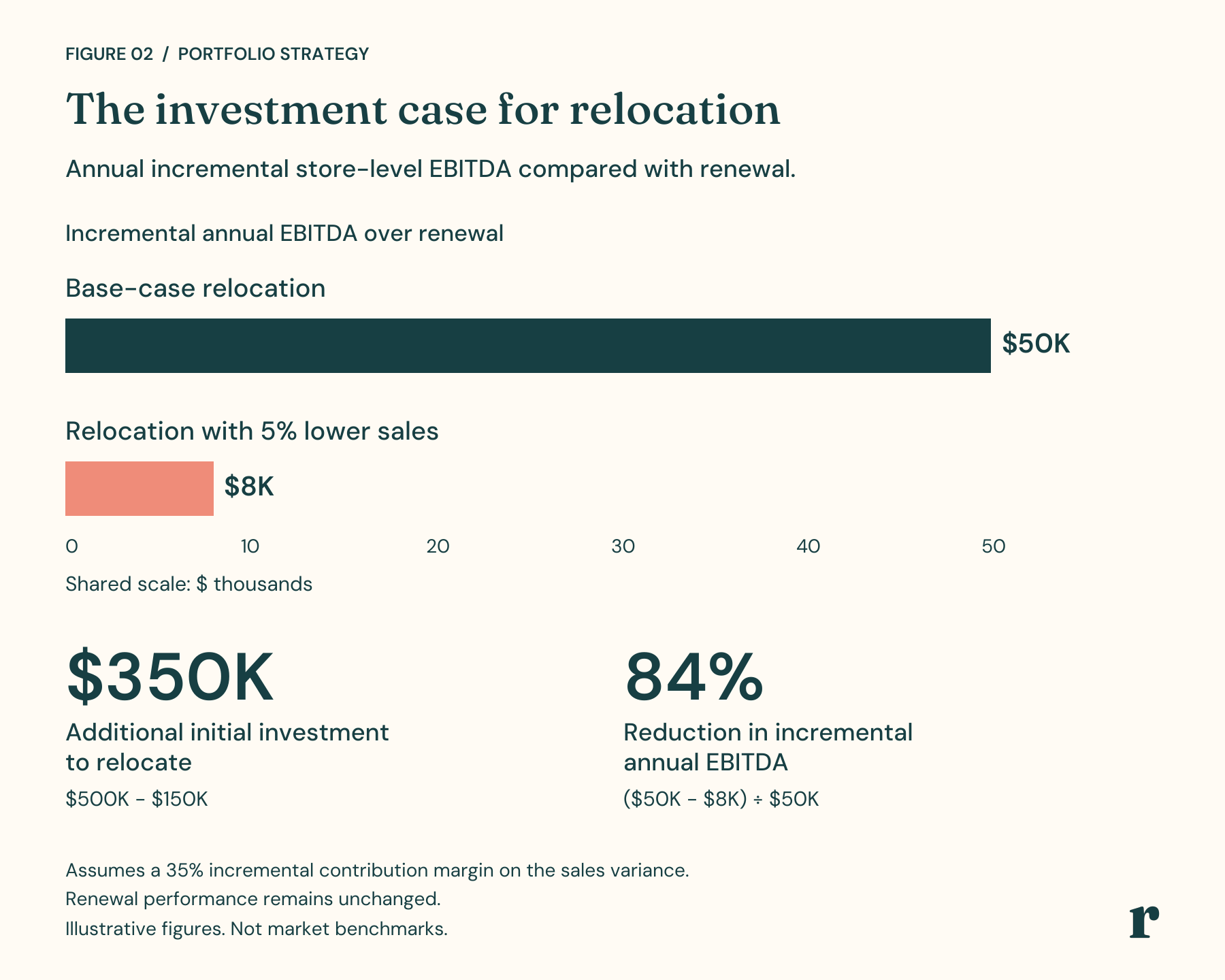
Data and calculations for Figure 02
| Relocation scenario | Base case | Sales downside |
|---|---|---|
| Annual sales | $2,400,000 | $2,280,000 |
| Annual store-level EBITDA | $308,000 | $266,000 |
| Incremental EBITDA over renewal | $50,000 | $8,000 |
| Additional initial investment | $350,000 | $350,000 |
Renewal reference scenario: annual sales $2,400,000; annual store-level EBITDA $258,000; total initial investment $150,000. Renewal performance remains unchanged in the downside comparison.
Base-case relocation: annual sales $2,400,000; annual store-level EBITDA $308,000; total initial investment $500,000. Incremental annual EBITDA over renewal: $308,000 − $258,000 = $50,000.
Relocation sales downside: −5% × $2,400,000 = −$120,000; annual sales $2,280,000. Assumed incremental contribution margin: 35%. EBITDA reduction: $120,000 × 35% = $42,000. Annual store-level EBITDA: $308,000 − $42,000 = $266,000. Incremental annual EBITDA over renewal: $266,000 − $258,000 = $8,000. Total initial relocation investment remains $500,000.
Additional initial investment to relocate: $500,000 − $150,000 = $350,000 in either relocation scenario.
Reduction in incremental annual EBITDA: ($50,000 − $8,000) ÷ $50,000 × 100 = 84%. The downside bar is $8,000 ÷ $50,000 = 16% of the base-case bar. Both bars use the same zero-based $0–$50,000 scale and represent incremental annual EBITDA over renewal, not total store-level EBITDA.
Assumes a 35% incremental contribution margin on the sales variance. Renewal performance remains unchanged.
Illustrative figures. Not market benchmarks.
The relocation continues to generate higher annual EBITDA than the renewal in this scenario, but the incremental benefit falls from $50,000 to $8,000.
A relatively modest sales variance has materially changed the justification for the additional capital.
The committee should see this sensitivity before approval. Customer origin analysis, the accessibility of the alternative premises and the proposed transition plan would consequently become important areas of further investigation.
For a new opening, the relevant sensitivities may include a slower sales ramp, higher construction costs or delayed possession. For a disposition, the analysis may instead depend on the cost of terminating the lease, the probability of securing an assignment and the impact on customer coverage.
The sensitivity analysis should reflect the specific investment being considered.
Separate outstanding risks from approval conditions
Some issues identified during due diligence can be quantified and incorporated into the investment case. Others require resolution before the company can responsibly proceed.
The package should distinguish between confirmed problems, unresolved questions and conditions attached to the proposed approval.
Consider a proposed restaurant location where the base-case capital budget assumes that the existing electrical service can accommodate the concept.
If the available capacity has not been verified, the construction estimate remains exposed to additional servicing costs and potential delivery delays.
The committee may decide to defer investment approval until capacity is confirmed. Alternatively, it may approve the investment subject to documented conditions, provided the company's governance process permits that approach.
An effective conditional approval identifies the issue, its potential consequence, the required resolution, the responsible party and the point beyond which the project cannot proceed.
A general instruction to complete due diligence leaves too much room for interpretation once the project moves into execution.
Establish when an approval needs to be revisited
Commercial terms and construction estimates can change between committee approval and lease execution.
A landlord contribution may be reduced during negotiations. A contractor's detailed estimate may exceed the preliminary capital budget. A delayed possession date may move an opening into a different financial year.
The original approval should establish the commercial parameters within which the project can proceed and identify which material changes require further authorisation.
For example, a committee approving a $500,000 investment may establish a maximum capital commitment, a minimum acceptable investment return and specific lease protections that must be secured before execution.
The appropriate thresholds depend on the company's delegated authority framework and investment requirements.
Where a revised proposal falls outside those parameters, the updated recommendation should explain what changed, quantify the financial implications and identify whether the original strategic rationale remains valid.
Record the decision and its implications for the portfolio
The committee record should capture the decision made, the approved commercial and capital parameters, any outstanding conditions and the authority granted to proceed.
It should also inform the wider development pipeline.
An approved opening creates dependencies across construction, recruitment, training, inventory planning and marketing. A renewal commits capital and occupancy costs that may affect the resources available for other projects. A deferred investment may release capacity for a different opportunity.
Rue Retail coordinates the preparation of these recommendations as part of its fractional real estate leadership function, working with the company's internal teams and local real estate professionals.
The client retains final investment approval and signing authority.
Following committee, the approved decision, outstanding conditions and anticipated delivery milestones should be reflected in the company's portfolio reporting, with responsibility assigned for each remaining action.